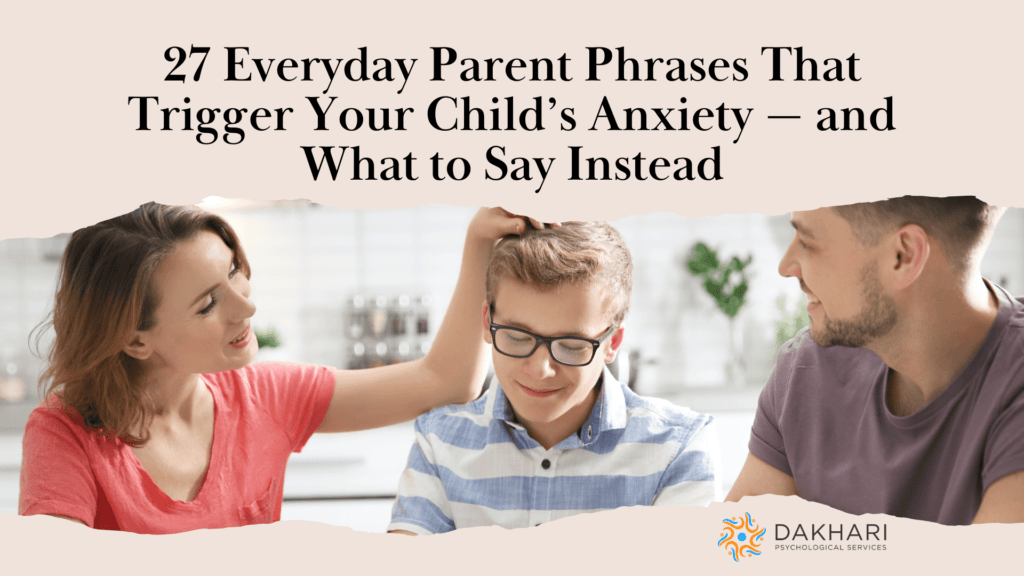
27 Everyday Parent Phrases That Trigger Your Child’s Anxiety — and What to Say Instead

FREE GUIDE FOR PARENTS

A short, practical guide that helps you recognize common parent phrases and teaches you what to say instead to support your child in anxious moments.

You’re Not Saying the “Wrong” Things — You’re Just Missing the Right Tools

You’re trying to help.
You’re trying to reassure.
You’re trying to calm things down.

But somehow, the moment you say:

“You’ll be fine.”
“Just try your best.”
“There’s nothing to worry about.”

Your child’s anxiety gets louder — not quieter.

This guide helps you understand why that happens and shows you
what to say instead.

When you change the words, you change how
your child’s nervous system responds.

Why Words Matter More Than We Realize

Children with anxious, sensitive, or high-achieving minds
don’t always hear words the way we expect.

A phrase meant to encourage can accidentally increase pressure.
A reassurance meant to soothe can unintentionally dismiss fear.

Changing the words we use is powerful.

Right when it matters, you’ll have words that support, validate, and ease anxious moments.

What's Inside?
27 Everyday Parent Phrases That Trigger Your Child’s Anxiety — and What to Say Instead

This digital resource includes:

  • 27 common parent phrases that often trigger anxiety

  • Clear explanations of why each phrase lands the way it does

  • What to say instead — practical, real-life alternatives

  • Focused responses that help kids feel understood

  • Parent-friendly language you can use immediately, even under stress

Dakhari Headshot

As a pediatric and clinical psychologist, I’ve spent over two decades helping people spot, challenge, and change unhelpful thoughts. I’ve worked with thousands of children, teens, and adults—and I’ve seen time and again that when evidence-based concepts are broken down into clear, structured steps, it becomes much easier to build healthier thinking patterns.

This guide is grounded in years of clinical experience helping parents navigate anxiety, big emotions, and high-pressure moments — and shaped by an understanding of what actually works in real homes, not just textbooks.

Details at a Glance

Format: Digital Guide

Access: Instant access after sign-up

Who it’s for: Parents of anxious, sensitive, perfectionistic, or high-drive kids

How to use it: As a quick reference, reflection tool, or daily support guide

Price: Free — no cost, no hidden fees. Get immediate access to practical, research-informed guidance to support your child with confidence.

Ready to Change What You Say in Anxious Moments?

You don’t have to keep guessing what to say when anxiety shows up.

Frequently Asked Questions

This guide is for parents and caregivers of children who experience anxiety, big emotions, sensitivity, or perfectionism. It’s especially helpful if you’ve ever wondered why your well-intended words don’t always calm your child.

This guide is perfect for kids ages 6–14, but you can easily adapt it to younger and older kids by adjusting the language and examples to fit your child’s personality, interests, and the way they approach new challenges.

This guide isn’t a cure for anxiety. It’s a support tool that helps reduce unintentional triggers and improves how you respond in anxious moments, which can make those moments feel calmer and more manageable.

No. The phrases are meant to be flexible. You can adapt the wording to fit your child’s age, personality, and your own voice.

This guide is educational and supportive but not a replacement for therapy. If your child’s anxiety is impacting daily life, working with a mental health professional may be helpful.

A short, practical guide that helps parents recognize common phrases that increase anxiety and replace them with supportive, regulating language that works in real moments.

Disclaimer & Terms

Due to the digital nature of our products and services, we do not offer refunds or returns for any reason.

The content in this product — including any references, resources, or links — is provided for informational purposes only. It should never be used as a substitute for direct medical advice, diagnosis, or treatment from your doctor or another qualified healthcare professional.

No content within this product should be taken as medical, clinical, or professional advice. Any action (or inaction) you take as a result of consuming this content is done solely at your own discretion and risk. The author and Dakhari Psychological Services, LLC cannot be held liable for any consequences of such action or inaction.

Accessing or using any content within this product does not create a doctor–patient relationship with the author or associated professionals. If you choose to share personal, medical, or clinical information with the author or associated professionals, that does not create a doctor–patient relationship.

For individualized advice regarding your health concerns, please consult directly with a qualified healthcare provider.