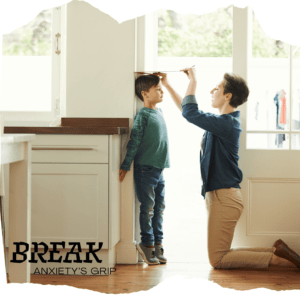
Help Me Help My Child:
Break Anxiety's Grip

So That I Can raise a child who feels supported—not pressured. stop second-guessing myself. respond—not react. show up when my child needs me most.

Parenting Is Stressful

On the outside, you’re keeping it together. But on the inside, your mind is buzzing through dozens of ‘what if‘ scenarios and you’re stuck wondering if you’re GETTING IT RIGHT…or making it worse for your child.
Stressed woman covering face

Overthinking is draining. Instead of finally feeling like you’re winning, you’ve got more doubt, bigger questions, and off the chart stress.  You know the ways that anxiety has taken charge in your life and you desperately want things to be DIFFERENT for your child.

NEVER, EVER just guess which strategies to try.
Learn how to match what you say and do to your child’s type of anxiety—
so it actually works.

When College Brings Excitement—and Anxiety
Excitement. Pride. Worry. Beneath the dreams and possibilities, anxiety often shows up—uninvited. Parents, now is the time to Break Anxiety’s Grip—so your teen can grow through this transition feeling capable, ready, and confident.
When Anxiety Starts
Running the Game
Stressing out and shutting down on game day? When the pressure to perform turns into nausea, nerves, and overwhelm, anxiety has already taken the spotlight. You know they're capable but anxiety is crushing them. It's time to
Break Anxiety's Grip.
When “Good Enough” Is Never Enough
Learning used to feel exciting. Achievement brought a sense of pride. Then perfectionism stepped in—turning effort into pressure, and success into something that never feels like enough. That’s when it’s time to
Break Anxiety’s Grip.
When Anxiety Gets in the Way of Confidence and Connection
When anxiety is in charge, it reshapes your child’s social world. Hesitation. Overthinking. Staying out of the conversation. You see it—and they feel it. Over time, that pattern chips away at confidence, making connection and friendships harder than they should be. Your child needs you to help them
Break Anxiety’s Grip.

No Parent Thinks..."My life is just too easy."

I created this Parenting Intensive Help Me Help My Child: Break Anxiety’s Gripbecause you’ve spent time trying to understand yourself—how you think and respond. You can see where your mind gets pulled into worry spirals—how quickly a thought can start to run, how convincing it can feel, how hard it is to just “let it go.”

And now you’re watching anxiety and stress show up in your child.

So you try to get ahead of it.  You think things through.  You choose your words carefully.  You want to respond in a way that teaches and truly helps—not just in the moment, but over time. Because this matters deeply to you. You want more for your child than just temporary anxiety relief. You want them to develop a different relationship with their thoughts—a grounded internal voice, and a story that gives them room to grow, not one that confines them the way yours sometimes has.

At the same time… you’re carrying a lot.

Work. Family. Parenting. Self-care. The mental load of keeping life moving forward for you and your family.  And trying to get it right in real time. That’s when it becomes clear—anxiety has been running the show for too long, and something needs to shift.

That’s when you know it’s time to Break Anxiety’s Grip.
On your mind. On your child. On the moments that matter most.


As we work through Help Me Help My Child: Break Anxiety’s Grip, I'll show you the exact tools and strategies I use to navigate stress, anxiety, and overwhelm with patients in mytherapy practice, with my children, and in my own day-to-day life.

      • Learn what works in real time and recognize anxiety as it’s actually happening—not just “big emotions” or difficult behavior, but patterns like overthinking, perfectionism, shutdown, and constant reassurance-seeking

      • Calm worry spirals quickly when you understand why logic doesn’t work in the moment and know what to do instead

      • Learn and practice proven body-based grounding strategies that help bring your child (and you) out of panic or overwhelm, so things don’t escalate the way they usually do

      • Break the loop seeing how anxiety pulls both of you into cycles—what-ifs, repeated questions, needing certainty—and learn how to interrupt those patterns without getting stuck in them

      • Stop accidentally triggering your child’s anxiety recognizing the moments where your response actually shapes what happens next—and know what to say instead

      • Stop avoidance and shut-down patterns, noticing how anxiety relentlessly shrinks your child’s world—through hesitation, refusal, and constant “I can’t” statements—and learn how to support them in facing what’s hard and building confidence without pushing too far or backing off too quick
       
      • Learn the thinking traps that fuel anxiety so you can catch your child before they fall in and help them get out of traps more quickly
       
      • Understand  the neuroscience of anxiety so you can meet fear with facts and practical evidence-based strategies
       
      • You’ll get practical exercises so you can help your child practice what you’re learning and improve their skills right away
       
      • Show your child how to persevere even in the face of anxiety.  BREAK ANXIETY’S GRIP and build lasting skills by shifting from managing moment-to-moment anxiety and stress to helping your child build real skills—so they can handle uncertainty, pressure, and discomfort and build confidence that grows with them!

I’m known for keeping things SERIOUSLY SIMPLE, dialing into what’s PRACTICAL, and teaching EVIDENCE-BASED strategies.

No—your child won’t just grow out of anxiety.

And waiting it out isn’t a strategy.

It would be so much easier if this were just a phase—something we naturally grow out of.  But anxiety doesn’t work like that.  It shows up in patterns—overthinking everything, avoiding what feels uncomfortable, needing constant reassurance, shutting down when things feel like too much.  And without the right support, those patterns don’t fade.  They become familiar. Automatic.  Waiting can come at a cost as unintended anxiety fertilizer.

Parents Tools Anxiety

So instead of waiting and hoping it passes, it’s time to
BREAK ANXIETY'S GRIP.
Because the patterns taking shape right now become what your
child leans on later.

This is what it starts to look like in REAL LIFE

Parenting That Actually Feels Good Again

Imagine parenting that feels steadier, stronger, more settled.  You’re modeling and teaching the exact skills you want your child to build—how to handle stress, tolerate discomfort, and think through hard moments.  You’re having more moments that feel calm and manageable, and noticing how your child is beginning to handle things differently, too.

Less Second-Guessing
More Steady Parenting

What if it started to feel like there was more joy and ease in your day-to-day parenting.  You’re not stuck wondering if you said the wrong thing—you know how to respond.  You’re not overthinking every interaction or questioning yourself afterward. You’re steady in the moment, even when things feel hard. And over time, your child begins to carry that same confidence forward—because anxiety has less of a grip on both of you.

Stop Searching
Start Knowing What to Do

You’re not looking for a script for every situation—but you’re done guessing your way through it. You understand what’s happening as it’s happening.  You know how to steady yourself and choose how to respond in the moment. Even when things aren’t clear, you’re not stuck. You can orient yourself, trust your next step, and move forward with intention. Because you don’t need a perfect plan. You have something better—a way to respond that holds up, no matter what shows up.

Learn STEP-BY-STEP from a Child Clinical Psychologist who understands the challenges firsthand.

I'll teach you what I know works (because I’ve done it for over 19 years in therapy with 1000s of anxious kids and parents!)

I’ve faced the unique challenges of raising an ‘extreme preemie’—now a teenager—while juggling the demands of multiple businesses and a career as a therapist. Let me be clear: I’m deeply passionate about my work, and I wouldn’t have it any other way. But if you’re anything like me—a “thinker”—you know exactly how it feels. Those intrusive thoughts? They’re like unwelcome guests, sticking around and scrutinizing every little detail, driving stress and anxiety sky-high.  Let me show you the way through – with the right tools you can quiet those voices, manage the overwhelm, and come out stronger and more resilient on the other side.

I combine evidence-based strategies with a deep understanding of how anxiety actually shows up in real life—so you’re not just getting information, you’re getting guidance that fits your child.

It’s about breaking anxiety’s grip on your child—and changing the direction they grow from here.

You’ll feel heard and supported, yes—but more than that, you’ll walk away with clear, practical tools you can rely on in real moments.  Because this isn’t just about getting through today’s stress.

Learn how to stop your own stress and anxiety from taking over—and sabotaging the parent you’re trying to be.

Pillar 1
Break Anxiety's Grip On Your Child Through Awareness

You Can’t Fight What You Don’t See Clearly. Your child’s anxiety may not always look like anxiety.  

And when anxiety goes unrecognized, parents often end up fighting the wrong problem.

They focus on the behavior…
while anxiety quietly keeps tightening its grip underneath.

That’s why Pillar 1 is the foundation of everything inside Break Anxiety’s Grip.

Because before you can respond effectively, support growth, or help your child move forward through fear…

You need the lens-correcting shift that helps you truly SEE what’s happening.

Show
Pillar 2
Break Anxiety's Grip On Your Child's Body

Your child’s anxiety does not just live in their thoughts.  It lives in their body, too.

Racing heart.  Tense muscles.  Restlessness.  Nausea.  Shallow breathing.  Trouble sleeping.  Sensory overload.  Freezing.  Crying.  Shutting down.  Explosive reactions.  Difficulty focusing.  Constant scanning for danger.

And when your child’s nervous system feels overwhelmed, reasoning alone stops working.

That’s where many parents get stuck.

They try to talk their child out of anxiety…
while their child’s body is still trapped inside it.

That’s why Pillar 2 is such a powerful next step inside Break Anxiety’s Grip.

Because once you can recognize anxiety clearly, the next step is learning how to help your child’s body stop staying locked in survival mode.

Show
Pillar 3
Break Anxiety's Grip On Your Child's Thoughts

Learn how to stop anxious thoughts from becoming your child’s unquestioned truth.

This pillar is not about forcing “positive thinking.”  It’s about helping your child develop more balanced thinking, greater perspective, increased uncertainty tolerance, better coping predictions, and stronger problem-solving skills

Pillar 3 is such a powerful next step inside Break Anxiety’s Grip because you get to learn how to help your child separate themselves from anxious thoughts.

Because the goal is not for your child to need constant reassurance from you forever.

The goal is helping them develop an internal voice that can eventually challenge anxiety themselves.

Show
Pillar 4
Break Anxiety's Grip Reclaiming Confidence, Growth & Forward Momentumn

Anxiety Shrinks Possibilities. This Pillar Helps Your Child Start Expanding Again.

Anxiety does not just affect thoughts and feelings.

Over time, it affects choices.

The activities your child stops trying.  The risks they stop taking.  The opportunities they hesitate to pursue.  The friendships they pull away from.  The experiences they avoid.  The independence they delay building.  The confidence they never get the chance to practice.

That’s why Pillar 4 is such an important final step inside Break Anxiety’s Grip.

Because awareness alone is not enough. Understanding the body is not enough.  Recognizing anxious thoughts is not enough.  Real growth happens when children begin practicing moving forward differently.  

Because the long-term goal is not avoiding discomfort.

It’s increasing confidence handling it.

Show

Help Me Help My Child: Break Anxiety's Grip

  • Format: Digital Course
  • Availability: Instant Access After Registration & Enrollment
  • Price Per Pillar: $49

Break Anxiety's Grip
On Your Child Through Awareness

Stop fighting the wrong problem.

Pillar 1

Break Anxiety's Grip
On Your
Child's Body

The right tools for the right moment.

Pillar 2

Break Anxiety's Grip
On Your Child's Thoughts

Stop anxiety from shrinking your child’s life down to fear, discomfort, and avoidance.

Pillar 3

Break Anxiety's Grip
Reclaiming Confidence, Growth & Forward Momentum

Pillar 4

Program Frequently Asked Questions

Q: How long does the course take to complete?

A: This course is broken down into 4 modules, or pillars, with each pillar focusing on a foundational area for breaking anxiety’s grip. Each pillar takes approximately 1 hour to complete in total, but it’s best to pace yourself rather than rush through it all at once. We recommend spacing it out by dedicating about 20 minutes at a time to each lesson within the pillar. This approach helps you maintain momentum while also giving yourself the space to fully absorb the concepts, practice the exercises, and begin applying what you’re learning along the way.

Q: Who can benefit from this?

A: This course is designed for parents of anxious kids, teens, and young adults. It’s especially meaningful for parents who recognize anxiety in themselves, too—because when anxiety shows up in your child, it often stirs something familiar in you as well.

Q: Are the strategies in the course evidence-based?

A: Yes, the strategies in the course are evidence-based. However, it's important to note that this is an educational course, not therapy.

Q: What if I want therapy after this course or am engaged in therapy during the course?

A: If you decide to pursue therapy for your child, yourself, or your family while taking this course—or afterward—that’s completely your choice. This course is designed to provide educational, evidence-based guidance and practical tools you can begin using right away. Whether you use it on its own or alongside therapy, the goal is to help you better understand anxiety and feel more confident responding to it in everyday life.

Q: How can I determine whether I should pursue therapy or enroll in this course?

A: That's a great question. It's important to note that this course is designed for educational purposes and is not intended to replace therapy. Consulting with your healthcare provider can assist you in determining the best course of action for your unique needs.

Q: How much time will I need to devote outside of the course?

A: Outside of the course itself, try to give yourself a little “real life practice time” each week. This doesn’t mean sitting down for another giant homework session—it might look more like catching yourself before offering reassurance, trying a new response during a school meltdown, noticing your own anxious thinking, or practicing one small strategy during the bedtime rush.

Most parents find that setting aside about an hour total throughout the week for reflection, practice, and experimenting with the tools helps the concepts really stick. Remember, this isn’t about perfection. It’s about building new patterns little by little—in the middle of real family life, forgotten backpacks, emotional mornings, and all.

Disclaimer & Terms

Due to the digital nature of our products and services, we do not offer refunds or returns for any reason.

The content in this product — including any references, resources, or links — is provided for informational purposes only. It should never be used as a substitute for direct medical advice, diagnosis, or treatment from your doctor or another qualified healthcare professional.

No content within this product should be taken as medical, clinical, or professional advice. Any action (or inaction) you take as a result of consuming this content is done solely at your own discretion and risk. The author and Dakhari Psychological Services, LLC cannot be held liable for any consequences of such action or inaction.

Accessing or using any content within this product does not create a doctor–patient relationship with the author or associated professionals. If you choose to share personal, medical, or clinical information with the author or associated professionals, that does not create a doctor–patient relationship.

For individualized advice regarding your health concerns, please consult directly with a qualified healthcare provider.