
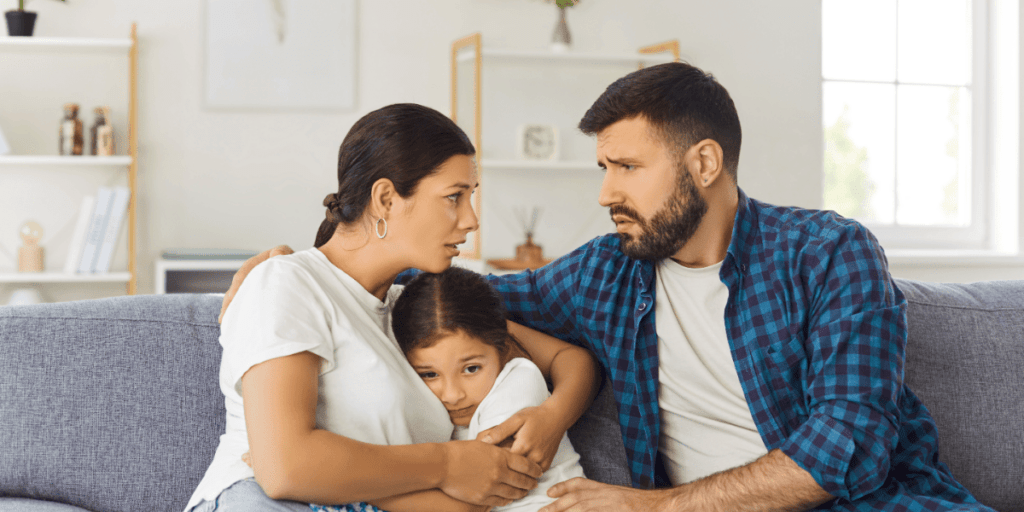
Some days, parenting an anxious kid can feel like playing a game of Clue, Guess Who and Operation all rolled into one. You’re using your best detective clue gathering skills to figure out your child’s anxiety, but it leaves you guessing who and what and definitely whhhhyyy is this happening??? If only there was something for child anxiety like that childhood operation game where you could remove the anxiety trigger pieces slowly and carefully without the buzzer going off and then…you win!! But instead, you’re throwing your hands up in desperation trying to figure out what actually caused your daughter to melt down because her pony tail was still “too bumpy Mom!” and why it seems like for the 8th time this week your 5th grader’s friend group drama has led to slammed doors and emphatic “you guys just don’t get it” being yelled through tears during what started off as a pretty regular family dinner.
Here’s the thing, child anxiety can show up in unexpected ways. The “why” isn’t always obvious, even when you’re paying close attention. Read on to learn more about how to spot child anxiety patterns and to respond in the moment without feeding the worry spiral.
Why child anxiety can look “random” at home

One of the more confusing parts of child anxiety is that it may not look like anxiety at all—especially at home. Many parents expect anxiety to show up as obvious worry, nervousness, or fear. But in reality, anxiety also appears as irritability, anger, shutdowns, or reactions that seem random. There are a few reasons for this.
IDEA #1 – First, home is often the safest place for emotional release. Children and teens often hold themselves together all day at school, sports, or social settings. They work hard to manage pressure, expectations, and social demands. When they finally get home, the nervous system relaxes—and the feelings that were held in all day spill out. What looks like sudden anger may actually be pent-up anxiety releasing once the pressure drops.
IDEA #2 – Second, child anxiety can live in the body before it shows up in thoughts. A racing heart, tight chest, stomach pain, or restlessness can build without a clear explanation. When the brain senses that internal alarm, it tries to make sense of it. Sometimes the result is frustration, irritability, or snapping at small things.
IDEA #3 – Third, children may not have the insight or language yet to identify anxiety. Instead of saying “I’m overwhelmed,” a child may slam a door, argue about homework, or react strongly to something minor. To a parent, it can feel like the reaction came out of nowhere.
So when child anxiety is underneath the behavior, what looks like anger, defiance, or randomness may actually be a nervous system that feels overloaded.
Gathering Helpful Child Anxiety ‘Data‘

When you can’t figure out what your child’s anxiety is about, it’s tempting to ask a lot of questions. “What happened?” “What are you thinking?” “Why are you doing this?” For many anxious kids, that spotlight can raise pressure fast. Then you end up with “I don’t know” or a bigger meltdown.
Here’s an approach to try instead that involves making and organizing observations and then using that information to ask well-crafted questions.
IDEA #4 – Start by troubleshooting your child’s behavior system. Track three simple behaviors for a week noting, 1) when it happens, 2) what was happening right before, and 3) what changed after. You’re looking for patterns.
It can help to get curious, get specifics, and then try to separate the trigger from the threat. The trigger is what happened (a math worksheet). The threat is what the brain predicts (“I’ll fail, everyone will know, I won’t be able to handle it”). Your child may only talk about the trigger and the threat can be more difficult to identify. Here are some ideas for ways to translate what you see into helpful guesses.
| What you see | What it might be protecting against | What helps in the moment |
|---|---|---|
| Repeated “Are you sure?” questions | Fear of uncertainty, fear of making a mistake | Calm, brief answer, then a coping step |
| Sudden anger or arguing | Loss of control, shame, overwhelm | Name the feeling, slow things down |
| Avoiding school, sports, or parties | Fear of failure, judgment, separation | Gentle plan, small exposure, steady limit |
| Lots of body complaints | Fear of sensations, fear of being “not okay” | Normalize sensations, grounding, check basics |
| Perfectionism, tears over small errors | Fear of not being good enough | Praise effort, allow “good enough,” repair |
Anxiety doesn’t have to shape your child’s future. If you’re raising a child, teen, or young adult who thinks deeply, feels intensely, or spirals quickly, you’ve likely felt that quiet pull between wanting to comfort them and wanting to truly help. Join 1,000+ parents receiving practical, psychology-backed strategies they can use in the moments that matter most. (Educational content only; not a substitute for professional advice.)

Searching for Patterns in Your Child’s Anxiety
Sometimes the hardest part of supporting an anxious child is figuring out what is actually driving the anxiety. Children and teens may struggle to explain it directly, and the trigger may not always be obvious in the moment. When reactions seem sudden, emotional, or out of proportion, it can help to slow down and look for patterns underneath the behavior. These strategies can help you start connecting the dots.
- IDEA #5 – Look for timing patterns. Notice when the behavior tends to show up—before school, Sunday evenings, before sports, or during transitions. Anxiety is often anticipatory and linked to what’s coming next.
- IDEA #6 – Watch for body clues. Stomachaches, headaches, fatigue, restlessness, panic, or trouble sleeping can all signal anxiety, even when a child doesn’t say they feel worried.
- IDEA #7 – Notice avoidance patterns. Repeatedly wanting to skip activities, delay tasks, or withdraw from situations can be a sign that something feels overwhelming or uncertain.
- IDEA #8 – Listen for small comments. Children often reveal anxiety indirectly through passing remarks like “Everyone is better than me,” “I’m going to mess it up,” or “What if something goes wrong?”
- IDEA #9 – Pay attention to what happens right before the reaction. A meltdown that seems random may actually follow a moment of pressure, embarrassment, or uncertainty.
- IDEA #10 – Compare settings. Notice whether your child seems calmer in some environments but struggles in others. Differences between school, activities, and home can reveal where the pressure may be highest. School expectations, social dynamics, academic pressure, and extracurricular demands can all contribute to anxiety that only becomes visible at home.
- IDEA #11 – Notice reassurance-seeking. Repeated questions like “Are you sure it will be okay?” or “What if something goes wrong?” can signal that your child is trying to reduce internal worry.
- IDEA #12 – Track energy and overload. Anxiety reactions often appear when a child is mentally or emotionally depleted. Busy schedules, social demands, and long school days can lower their capacity to cope.
While these observations won’t provide every answer, they can help you see patterns that make your child’s reactions easier to understand—and that understanding often makes it easier to respond in ways that calm the nervous system rather than escalate the stress.
One Step At a Time
Pick one small aspect of your child’s anxiety to focus on this week and stick with it long enough to notice patterns. Often, a first step to creating lasting change is to gather good data about what’s happening. If you want ongoing, practical, evidence-based support, sign up for our newsletter, Anxiety Doesn’t Call the Shots. If you feel that you are ready to help your child take small steps toward facing their fears, read our post on how to build exposure ladders for helpful tools. Remember, this information is valuable but cannot replace, personalized care from a licensed professional.

J. Oni Dakhari, PsyD
ABOUT THE AUTHOR: J. Oni Dakhari, PsyD, is a clinical and pediatric psychologist who loves languages, is an avid traveler, and finds boundless excitement in the pursuit of knowledge and helping others.
Health Information Disclaimer: Attention Required
No content on this site, or any of the references or links, should ever be used as a substitute for direct medical advice from your doctor or other qualified clinician. The content of the blog, including any references, resources, links, or other shared knowledge, is for informational purposes only. No content whatsoever should be taken as a replacement for medical, clinical, professional advice, diagnosis, intervention, or treatment. Any action or inaction as a result of any content you consume, including within the blog, references, resources, links or other associated knowledge, is done solely at your discretion.
The blog author and associated professionals cannot be liable for any of the consequence of such action or inaction. Accessing or using any of the content of the blog, including any references, resources, links, or other shared knowledge does not create a doctor-patient relationship between the author or associated professionals and you. If you choose to contact the blog author or any associated professionals of Dakhari Psychological Services, LLC to provide personal, medical, or clinical information, this does not create a doctor-patient relationship. It’s crucial to consult with a qualified h ealthcare provider for individualized advice regarding your health concerns.
Affiliate Disclosure Disclaimer:
Please note this post may contain affiliate links. This means I may receive a commission if clicked at no extra cost to you.