

Many parents come in worried about what looks like constant anger. Their child snaps quickly, argues over small things, or melts down in ways that seem bigger than the situation calls for. It can easily feel like defiance or attitude, especially when the reaction appears to come out of nowhere.
But later, when everything settles down, a different story sometimes emerges. A child might quietly admit that they were afraid they were going to mess something up, or that they thought other kids would laugh at them, or that they simply didn’t know what was going to happen next. In those moments, parents often realize that what looked like anger was something else underneath.
Understanding that anxiety can look like anger can lead to deeper conversations with our kids and teens about their feelings. In fact, since anxiety can look like anger to both kids and adults, it can be quite confusing. Anxiety doesn’t always look like worry or nervousness. Quite often it shows up as irritability, arguing, or emotional explosions that seem disproportionate to the situation. For many families, understanding that anxiety can look like anger helps clarify those confusing moments. Once parents recognize how anxiety and anger can overlap, many of those confusing moments begin to make more sense.
When Anxiety Looks Like Anger in Kids: How Parents Can Tell the Difference
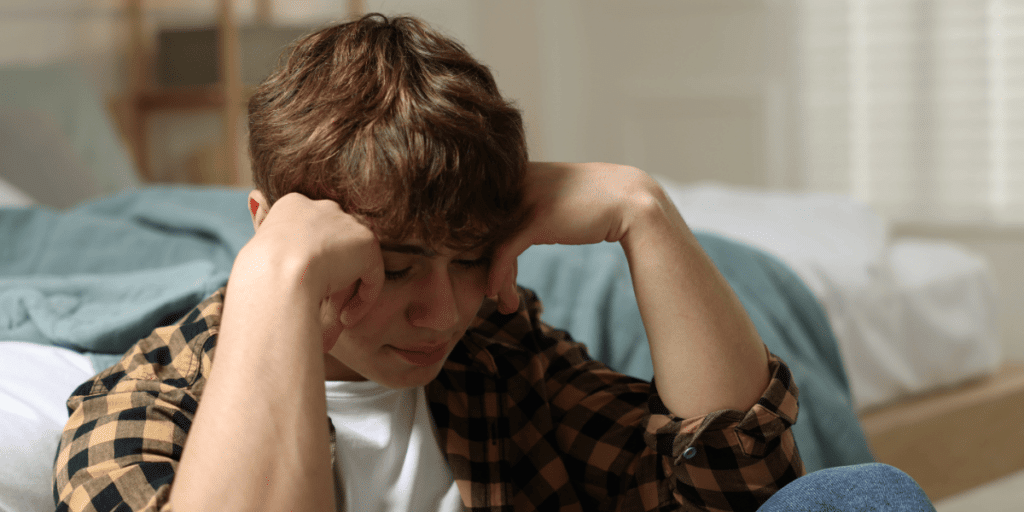
When parents acknowledge that anxiety can look like anger, it can allow you to approach situations differently, foster a supportive environment that encourages your kids to express themselves more openly, and help identify underlying issues.
When your child feels anxious, their brain interprets the situation as a potential threat. The amygdala, which acts like the brain’s alarm system, signals the body to prepare for danger. Heart rate rises, muscles tighten, and the nervous system shifts into what we commonly call the fight-or-flight response.
Some children, teens, and young adults respond to that surge by withdrawing or avoiding the situation entirely. Others react through the “fight” side of the response. When that happens, anxiety may come out as arguing, blaming, demanding control, or pushing back against instructions.
This is why anxiety and anger in kids are often mistaken for each other. From the outside, it can look like a child is simply being oppositional. From the inside, the child may be trying to reduce a feeling of fear or uncertainty as quickly as possible.
You might notice this pattern when a child feels trapped by situations involving uncertainty, evaluation, or change. A child who worries about making mistakes may react strongly when homework is corrected. A child who fears embarrassment might argue before a performance or social event. Even something as simple as a change in plans can trigger a sense that things are suddenly out of control.
Physical stress signals can add to the confusion. Tight shoulders, clenched fists, pacing, stomachaches, and a flushed face can look like classic anger cues. In reality, these are also very common signs that a child’s nervous system is under stress.
Another pattern many parents notice is the after-school explosion. A child may spend the entire day working hard to keep their worries contained at school. When they finally reach the safety of home, the pressure releases, and a relatively small frustration can suddenly trigger a much bigger reaction.
When anxiety is underneath the behavior, often kids are not trying to create chaos or manipulate the situation. Their nervous system is simply trying to find a way back to safety. Sometimes the anger you see in anxious kids shows up during intense spikes of fear. If your child has ever had moments where anxiety suddenly escalates into panic, it may help to understand what those experiences look like and how to respond calmly in the moment. Our post on Panic Attacks: How to Support Your Child Through Them walks through practical ways parents can help when anxiety escalates quickly.
Anxiety vs. anger: the quickest ways to tell what’s driving the moment
Keep this in mind too, kids can feel angry and anxious at the same time. Research shows these feelings can often travel together, (see the relationship between anger and anxiety symptoms in youth). So you’re not “missing it” if it feels mixed.
Although anxiety and anger often overlap, there are usually a few clues that can help parents sort out what might be driving the moment. Paying attention to the trigger, the goal of the behavior, and what happens afterward can offer helpful information.
| What you notice | More like anxiety | More like anger |
|---|---|---|
| Common trigger | Uncertainty, mistakes, social worry, transitions | Feeling wronged, blocked, or disrespected |
| What your child is trying to do | Avoid, escape, or gain certainty | Protest, regain power, or set a boundary |
| Body signals | Shaky, tense, rapid breathing, nausea | Hot, amped up, loud voice, “ready to explode” |
| Words you hear | “I can’t,” “What if…,” “Don’t make me” | “No,” “Stop,” “That’s not fair” |
| Timing | Peaks before an event, then drops | Peaks during conflict or limit-setting |
| After the storm | Shame, tears, clinginess, reassurance-seeking, needing help to express emotions safely | Still mad, defensive, blaming, or seeking payback |
The takeaway – anxiety often has a “threat” feel that drives your child’s behavior, even when the threat isn’t logical. Anger often has an “injustice” feel, even when the response is ‘too big’.
One practical strategy that can help is something I call the rewind test. When an outburst happens, mentally rewind the situation by about ten minutes. Ask yourself whether your child was facing pressure, uncertainty, or fear about something that was coming up. If so, anxiety may have been steering the reaction. If the rewind shows a clear conflict—perhaps a sibling taking something, a limit being set, or a perceived injustice—anger may have been the main driver.
Anxiety doesn’t have to shape your child’s future. If you’re raising a child, teen, or young adult who thinks deeply, feels intensely, or spirals quickly, you’ve likely felt that quiet pull between wanting to comfort them and wanting to truly help. Join 1,000+ parents receiving practical, psychology-backed strategies they can use in the moments that matter most. (Educational content only; not a substitute for professional advice.)

What to Do Next When Anxiety Looks Like Anger (without rewarding the meltdown)

Once you recognize that anxiety may be playing a role, the goal shifts slightly. Instead of focusing on correcting the behavior immediately, the priority becomes helping your child’s nervous system settle. When the body is flooded with stress signals, reasoning rarely works well. A calmer body creates the conditions where learning and problem-solving can happen.
In the moment: regulate first, then problem-solve
When your child is flooded, reasoning won’t land well. Being aware of how anxiety actually can look alot like anger can also empower children to express their feelings better. Try this to start off with calm structure.
- Stay calm and model calmness: get quieter, slow your pace, and use fewer words.
- Validate feelings: “Something feels really hard right now.”
- Set one limit (if needed): “I won’t let you hit.”
- Offer one choice: “Couch or bedroom or time-out to cool off?”
In practice, this usually means slowing the moment down. Parents who lower their voice, reduce the number of words they use, and acknowledge the difficulty of the moment often help the situation stabilize more quickly. A simple statement such as, “Something feels really hard right now,” can signal understanding without escalating the conversation.
Ultimately, understanding that anxiety can look like anger leads to healthier emotional development.
Clear limits still matter. If your child is hitting, yelling, or breaking things, it is appropriate to calmly state what cannot happen. The key difference is that the limit is delivered in a steady tone rather than in the heat of the conflict.
Short resets can also help interrupt the escalation. A few minutes of quiet space, a drink of water, or a brief pause can allow the nervous system to settle enough for your child to regain some control. In school environments, similar strategies—such as a predictable reset spot or brief break—often help prevent a stressful moment from turning into a prolonged power struggle.
After the Storm: Helping Kids Understand What Happened
Questions such as “What felt hardest right before you got upset?” or “Were you trying to stop something frustrating from happening?” can help children begin to recognize the connection between their feelings and their behavior.
If anxiety was part of the picture, the next step is helping the child develop tools that make future situations easier to handle. This might involve practicing calm breathing, developing simple coping statements, gradually facing stressful situations in manageable steps, or creating routines that reduce uncertainty.
If anger was the primary emotion, the focus may shift toward repair skills—apologizing, fixing what was broken, or practicing a different response for next time.
Parents can reinforce these skills by noticing recovery. Comments such as “You were able to calm your body” or “You figured out how to do a ‘do-over’. Way to go!” highlight progress and encourage your child to keep building those abilities.
For many families, the long-term solution is guiding kids and teens toward gradually facing the situations that trigger anxiety rather than avoiding them. If you want a step-by-step example of how this works in real life, you might find our post helpful: Exposure Ladder Examples for Kids: A Parent-Friendly Guide to Facing Fears Gradually. It shows how small, manageable steps can help children build confidence around fears.
Considering Extra Support When Anxiety Looks Like Anger
For some families, anxiety versus anger patterns show up repeatedly across different environments—home, school, and social situations. When that happens, additional guidance can be helpful.
You may want to consider extra support if outbursts become frequent, if your child begins avoiding school or activities they once enjoyed, or if aggressive or unsafe behavior appears. Families sometimes also seek help when they feel as though everyone in the household is constantly walking on eggshells.
A pediatrician, school counselor, or child therapist can help evaluate what might be driving the pattern and recommend strategies that fit your child’s needs. Evidence-based approaches such as cognitive behavioral therapy and parent coaching programs are often effective in helping children, teens, and young adults learn to manage anxiety and regulate strong emotions more consistently.
One pattern that can quietly keep anxiety and anger cycles going is something psychologists call parent accommodation—when well-intended adjustments temporarily reduce anxiety but accidentally reinforce it over time. If you’re curious about how that dynamic works, our post helps to explain: What Is the Parent Accommodation Trap? How It Fuels Anxiety—and How to Break the Spiral.
Takeaway
When parents learn to recognize the times when anxiety looks like anger in our kids, many confusing moments begin to feel more understandable. Watching for the trigger, the goal of the behavior, and what happens afterward can provide helpful clues about what your child is experiencing internally.
From there, the most helpful response is usually to calm the body first – both in intense anxiety and anger responses – then, maintain clear boundaries, and teach coping skills once the moment has passed. Progress rarely moves in a straight line and we already know that it certainly doesn’t look like perfect behavior overnight. More often it appears as shorter meltdowns, quicker recovery, and a growing ability for our children to understand and manage their emotions.

J. Oni Dakhari, PsyD
ABOUT THE AUTHOR: J. Oni Dakhari, PsyD, is a clinical and pediatric psychologist who loves languages, is an avid traveler, and finds boundless excitement in the pursuit of knowledge and helping others.
Health Information Disclaimer: Attention Required
No content on this site, or any of the references or links, should ever be used as a substitute for direct medical advice from your doctor or other qualified clinician. The content of the blog, including any references, resources, links, or other shared knowledge, is for informational purposes only. No content whatsoever should be taken as a replacement for medical, clinical, professional advice, diagnosis, intervention, or treatment. Any action or inaction as a result of any content you consume, including within the blog, references, resources, links or other associated knowledge, is done solely at your discretion.
The blog author and associated professionals cannot be liable for any of the consequence of such action or inaction. Accessing or using any of the content of the blog, including any references, resources, links, or other shared knowledge does not create a doctor-patient relationship between the author or associated professionals and you. If you choose to contact the blog author or any associated professionals of Dakhari Psychological Services, LLC to provide personal, medical, or clinical information, this does not create a doctor-patient relationship. It’s crucial to consult with a qualified h ealthcare provider for individualized advice regarding your health concerns.
Affiliate Disclosure Disclaimer:
Please note this post may contain affiliate links. This means I may receive a commission if clicked at no extra cost to you.