

Your kid loves the sport, yet games can turn them into a different person. Maybe they get quiet, clingy, snappy, or suddenly “forget” how to do things they do every day in practice. If you’ve seen that switch flip, you’re not alone. Youth sports anxiety is common, and it can show up even in confident, hard-working youth athletes.
The good news is you don’t need a perfect speech, more drills or hours more practice. That switch often stems from fear of failure, overly harsh self-criticism, or perfectionism. A few go-to phrases plus a plan for what to do before, during, and after competition can be a game changer. Literally! The scripts below help your child calm their body’s response, protect confidence, and still keep expectations clear.
What performance anxiety in youth sports looks like (and why it’s not “bad attitude”)
Sports performance anxiety in kids often looks like avoidance, anger, tears, or even “I don’t care.” Under the surface, it’s usually based in fear. Fear of messing up, being judged, letting others down, or losing their spot. Their brain treats the game like a threat, so their body reacts as if it needs to fight, flee, or freeze.
You’ll often see a mix of mind and body signs:
- Body clues: stomachaches from gastrointestinal distress triggered by stress hormones, tension headaches, shaky hands due to adrenaline surges, tight chest from rapid shallow breathing, nausea, and trouble sleeping the night before caused by a hyperactive mind.
- Behavior clues: extra bathroom trips, asking the same questions repeatedly, sudden “injuries,” perfectionism or social anxiety as an underlying factor, melting down over small mistakes.
- Game-time clues: playing too safe to minimize injury risk, rushing shots or passes, freezing up entirely, avoiding the ball, apologizing constantly, or snapping at teammates.
A key detail helps you respond better: anxiety is trying to protect your child, even when it’s clumsy. So if you treat it like defiance, you usually get more of it. If you treat it like a stress response, you can guide them back to coping skills or use this as an opportunity to teach new ones.
It also helps to separate normal nerves from problematic anxiety that needs extra support, such as intense fear of failure. Normal nerves rise and fall, and your child can still play. Problematic anxiety tends to stick, spread (practice, school, sleep), or cause repeated shutdowns.
For more context on competitive anxiety and how it affects young athletes, you can skim Managing competitive anxiety in young athletes.
Coach and parent scripts before and during competition

When you’re in the stands or on the sideline, your job isn’t to erase nerves. It’s to lower the alarm so your child can access the coping skills they already know. If your child looks panicked, aim for regulation first, then coaching. A calm body can hear instruction. A stressed brain can’t.
Pre-game scripts (20 to 60 seconds)
Start by naming what’s happening without making it dramatic. Then point them toward a simple ‘next step’ goal.
Parent script, before warm-ups
“I can see your nerves. That’s your body getting ready. Let’s help it settle.”
“Two deep breathing exercises with me. In through your nose, out through your mouth.”
“Today, your job is effort, focus, and being a good teammate. I love watching you play.”
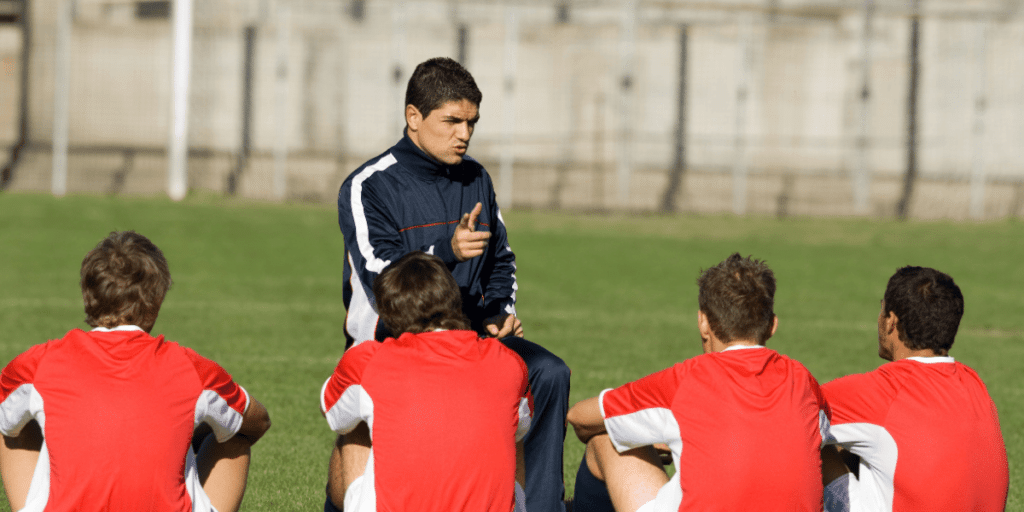
Coach script, in a huddle
“Some nerves are normal. You don’t have to feel fearless to play well.”
“Pick one focus: strong first touch, talk on defense, or hustle back.”
“Make the next play. That’s it.”
One quick tool that works well is a “two-lane” choice. You offer structure, and they choose the lane.
Two-lane choice script (parent or coach)
“Do you want a quiet minute, or do you want to move your body and stay busy?”
“Do you want one reminder, or none until after the first swing?”
During the game scripts (when you want to yell advice AND stay helpful)
Most kids with youth sports anxiety scan for danger. Your tone becomes “the weather.” So your words should be short, neutral, and action-based to safeguard athletic performance and build mental toughness.
Here’s a simple guide you can keep in your head:
| Moment | Parent script | Coach script |
|---|---|---|
| Mistake happens | “Next play.” | “Reset. Find your job.” |
| They look scared | “Breathe, then move.” “Trust your game.” | “You’re good. Keep your eyes on his left hand during the next play.” |
| They’re stuck on outcomes | “One play at a time.” | “Let’s win the next 10 seconds. Keep your knees flexed and hands ready.” |
| They’re angry | “Play the moment!.” “Reset and go!” | “Hands down, eyes up, blow it out, next play.” |
Notice what’s missing: detailed mechanics, sarcasm, or comparisons. You can focus on skill development in practice. In games, you mostly protect their ability to try again.
If your athlete spirals into “I can’t,” which often signals choking under pressure, keep your response neutral and steady: “You can do hard things while you feel nervous.”
Anxiety doesn’t have to shape your child’s future. If you’re raising a child, teen, or young adult who thinks deeply, feels intensely, or spirals quickly, you’ve likely felt that quiet pull between wanting to comfort them and wanting to truly help. Join 1,000+ parents receiving practical, psychology-backed strategies they can use in the moments that matter most. (Educational content only; not a substitute for professional advice.)

After the game scripts that build confidence (without ignoring hard moments)
Post-game is where anxiety often grows under pressure. Your kid replays mistakes like a highlight reel. Or they chase reassurance: “Was I bad?” “Are you mad?” If you find yourself answering those questions 20 times, you accidentally train their brain to keep asking. To help minimize this post game anxiety think: step 1 – connection, step 2 – review with limits.
Right after the whistle: connect and de-pressure
Parent script, 10 seconds
“I’m glad to see you.”
“I love you, win or lose.”
“You don’t have to talk yet.”
Coach script, 10 seconds
“Good effort staying with it.”
“We’ll learn from this in practice.”
“Grab water, then we’ll reset.”
That small pause matters because kids can’t process feedback while flooded.
Your first job after a tough game is to show your athlete that they still belong, they’re still accepted, and mistakes don’t equal punishment or fear. Feeling connected lowers anxiety.
Later that day: post-game analysis in a way that doesn’t feed rumination
When you do talk, keep it structured. Try a two-part reflection.
Two-part reflection script (parent or coach)
“Name one thing you did that helped the team.”
“Name one thing you’ll practice, and we’re done.”
If your child can’t find a positive, you can lend them one that’s real: “You kept going after that mistake. That’s a skill.”
If your child keeps circling back to the same fear or mistake, set a kind boundary:
“I’ve answered that. Your brain is stuck on the worry loop. Let’s do something that helps your body and brain settle.”
Some families also like to add a short, values-based message that puts performance in its place and reinforces identity beyond sport.
Seeking Additional Support
When performance anxiety causes overly harsh self-criticism, panic, frequent upset stomach or vomiting, ongoing sleep loss, or a big change or drop in mood, it’s also reasonable to talk with a licensed mental health professional for extra support to protect long-term mental health.
You can’t force anxiety out of an athlete by demanding confidence, because anxiety doesn’t respond to pressure in that way. It responds to safety, structure, and repetition that builds muscle memory for coping strategies and helpful self-talk. Short scripts before, during, and after games, rooted in sport psychology, mirror techniques elite athletes use to stay composed. Looking for ways to coach facing fears one step at a time? Read our post on exposure ladders: Exposure Ladder Examples for Kids: A Parent-Friendly Guide to Facing Fears Gradually. Remember, you can teach your child a bigger lesson than any scoreboard, one that builds self-esteem and lasting coping mechanisms.

J. Oni Dakhari, PsyD
ABOUT THE AUTHOR: J. Oni Dakhari, PsyD, is a clinical and pediatric psychologist who loves languages, is an avid traveler, and finds boundless excitement in the pursuit of knowledge and helping others.
Health Information Disclaimer: Attention Required
No content on this site, or any of the references or links, should ever be used as a substitute for direct medical advice from your doctor or other qualified clinician. The content of the blog, including any references, resources, links, or other shared knowledge, is for informational purposes only. No content whatsoever should be taken as a replacement for medical, clinical, professional advice, diagnosis, intervention, or treatment. Any action or inaction as a result of any content you consume, including within the blog, references, resources, links or other associated knowledge, is done solely at your discretion.
The blog author and associated professionals cannot be liable for any of the consequence of such action or inaction. Accessing or using any of the content of the blog, including any references, resources, links, or other shared knowledge does not create a doctor-patient relationship between the author or associated professionals and you. If you choose to contact the blog author or any associated professionals of Dakhari Psychological Services, LLC to provide personal, medical, or clinical information, this does not create a doctor-patient relationship. It’s crucial to consult with a qualified healthcare provider for individualized advice regarding your health concerns.
Affiliate Disclosure Disclaimer:
Please note this post may contain affiliate links. This means I may receive a commission if clicked at no extra cost to you.