
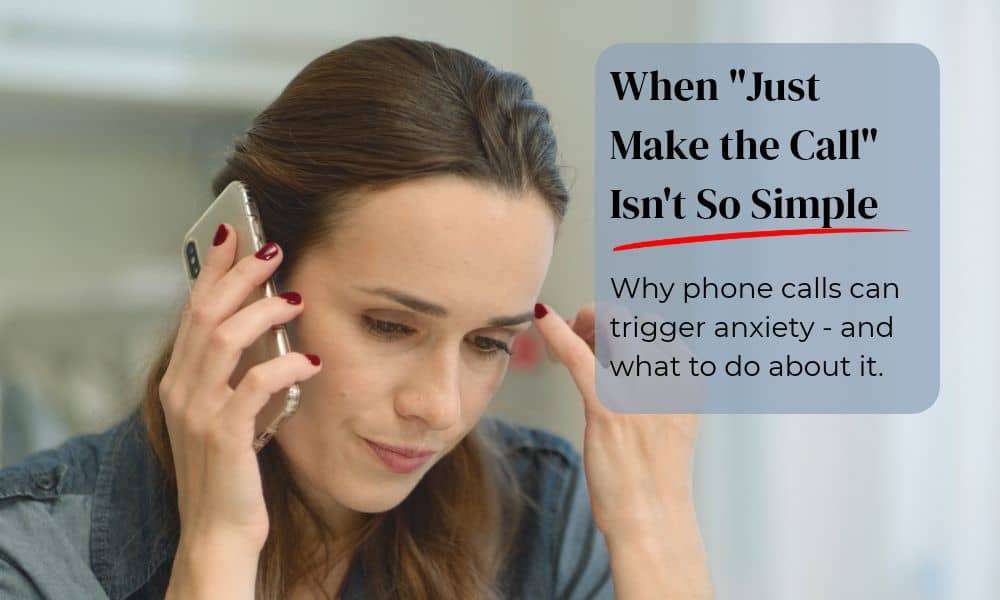
Phone call anxiety can happen when your brain treats a conversation as a situation where you fear being judged, misunderstood, or caught unprepared. Without facial expressions or time to edit your response, even a routine call can feel demanding. You may know what you need to say and still feel your stomach tighten when the phone rings. Understanding this stress response can help you approach calls with more support and less self-criticism, beginning with what makes them feel threatening.
One important distinction: Not every uncomfortable phone call is a sign of anxiety that needs treatment. It’s common to feel nervous about unfamiliar conversations, difficult topics, or situations where the stakes feel high. The concern is less about whether you feel anxious and more about whether that anxiety is consistently interfering with your ability to do things that matter to you. If fear of phone calls is leading to ongoing avoidance, significant distress, or difficulties managing everyday responsibilities, consider seeking support from a qualified mental health professional. You don’t have to wait until anxiety becomes overwhelming to ask for help.
TL;DR
- Phone anxiety often involves uncertainty, fear of judgment, and missing visual cues.
- Brief talking points and gradual practice can help you communicate while feeling nervous.
- Professional support is appropriate when avoiding calls interferes with healthcare, relationships, school, or work.
What Is Phone Call Anxiety Anyway?
Telephobia, also called telephonophobia or telephone phobia, describes fear or reluctance around making or receiving calls. It’s commonly discussed as a form of social anxiety, although the term alone doesn’t establish a diagnosis. You might worry about stumbling over words, misunderstanding the caller, or being unable to explain yourself. This resembles performance anxiety. Like glossophobia, the fear of public speaking, telephone anxiety can involve anticipating criticism from an audience, even when that audience is one person. Physical symptoms may include a nervous stomach, sweaty palms, rapid heartbeat, nausea, dry mouth, trembling, or shortness of breath. Intense anxiety can develop into panic, sometimes with hyperventilation. You’re not alone in this experience. A survey of 500 UK office workers reported call-related anxiety in 62% of respondents, rising to 76% among millennials.
Why Phone Calls Can Feel Threatening

You lose cues that help you feel understood
In person, body language, such as a smile or nod, can reassure you that someone understands. Phone conversations offer fewer clues about what the other person is thinking. A pause might mean they’re checking their calendar, but negative thoughts can turn it into a sign of disapproval. You may then monitor every word, trying to sound calm, friendly, and competent. Dividing your attention between the conversation and your performance makes it harder to follow what the other person says.
You may feel that you have less control over what happens next
An unfamiliar voice, unexpected question, poor connection, or possibility of bad news can make phone calls feel unpredictable. A previous experience with a rude caller may also shape what you expect. Texting gives you time to organize and revise your thoughts. If you mostly communicate that way, spontaneous phone conversations may feel less familiar. Avoidance can provide immediate relief, but it also limits opportunities to learn that you can manage uncertainty. Sometimes, practical difficulties matter too. Hearing differences, language barriers, or needing more processing time deserve consideration as well.
Before You Dial: Three Ways to Prepare
You can prepare before the call in ways that support the conversation without requiring you to feel completely ready.
- Write general talking points. Note your purpose, essential information, and main question. For an appointment, have your calendar, relevant identification, and contact details nearby. A few prompts are easier to follow than a full page.
- Practice without memorizing every word. Say your opening aloud once or twice, then allow different wording. Memorizing can increase pressure if the conversation takes an unexpected direction. You need enough structure to begin, with room to respond naturally.
- Remember who you’re speaking with. A receptionist is helping arrange appointments; an interviewer is gathering information. Returning to the shared task can reduce the feeling that you’re being evaluated as a person.
Choose a reasonably private space if being overheard adds pressure. Before dialing, let your feet rest on the floor and take a few comfortable, unforced breaths. Our coping tools for overwhelming moments offer additional support when emotions feel intense.
What to Say When You Don’t Know What to Say
One of the biggest worries about making a phone call is the possibility of getting caught off guard. What if someone asks a question you weren’t expecting? What if your mind goes blank? What if you start talking and lose track of what you were saying? Here’s something worth remembering: You don’t need a perfectly rehearsed response for every situation. Most conversations involve pauses, clarifications, and moments when someone needs a little more time. Having a few go-to phrases can make those moments easier to navigate.
When someone asks a question you don’t know how to answer
- “That’s a good question. Let me think about that for a second.”
- “I’m not entirely sure. Can I check on that and get back to you?”
- “I don’t have that information in front of me, but I can find out.”
You don’t have to produce an immediate answer just because someone asked a question.
When your mind goes blank or you lose your train of thought
- “Hang on, I just lost my train of thought.”
- “Let me start that again.”
- “I had a couple of things I wanted to ask. Let me check my notes.”
A momentary blank doesn’t mean the conversation is going badly. It just means you need a moment to regroup.
When you need time to process what someone said
- “Let me make sure I’m understanding you correctly.”
- “Could you walk me through that one more time?”
- “That’s helpful. Let me jot that down.”
- “Can you give me a second to think about that?”
These phrases let you slow the conversation down without making the pause feel like a big deal.
When you feel like you’re rambling or not making sense
- “I think I’m making this more complicated than it needs to be.”
- “Let me put that a different way.”
- “Actually, the main thing I wanted to ask is…”
You can redirect yourself in the middle of a conversation. You don’t have to finish an explanation that’s gotten away from you.
When you don’t know what to say next
- “Okay, so what would be the next step?”
- “Is there anything else you need from me?”
- “That gives me something to think about. Thanks for explaining.”
Sometimes the easiest way forward is simply to ask a question or acknowledge what the other person has said.
When you’re ready to end the call
- “Okay, I think that covers everything. Thank you!”
- “I appreciate your help. Have a good day.”
- “Great, I’ll follow up on that. Thanks again.”
You don’t need an elaborate closing. A friendly acknowledgment is enough.
The Skill Isn’t Having the Perfect Words
Notice what these phrases have in common. None requires you to hide that you’re thinking, unsure, or momentarily at a loss for words. That’s actually part of what makes them useful. The goal isn’t to eliminate awkward moments. It’s to learn that you can handle them without having to escape the conversation. And the more you practice navigating those little moments, the less important it becomes to predict every possible turn a phone call might take.
A pause gives you information only after you know what caused it. Silence alone doesn’t tell you someone is judging you.
Afterward, it can be incredibly helpful and calming to ‘describe what happened’ rather than ‘replaying how you think you came across’. Our strategies for managing overthinking can help when post-call worry keeps pulling your attention back.
Build Confidence Through Gradual Phone Practice

Gradual exposure means approaching feared situations in manageable steps. Repeated practice can support desensitization, or becoming less reactive over time. The National Institute of Mental Health describes exposure therapy for phobias as a way to address the fears underlying avoidance. Begin with one of several low-stakes calls that has a genuine, manageable purpose. You might ask a coffee shop about closing times or ask a customer service representative about additional product options. Later steps could include leaving a voicemail, scheduling an appointment, or handling a longer work conversation. As a practical starting point, plan several opportunities each week. There’s no universal number of days you must practice before progressing. Support from someone else can help you begin.
When Phone Anxiety Could Benefit From Professional Support
Notice how much it affects your life
Preferring texts certainly doesn’t mean you have an anxiety disorder. Consider whether fear repeatedly prevents you from arranging healthcare, responding to work opportunities, maintaining relationships, or managing everyday responsibilities. You may also notice extensive preparation, repeated reassurance-seeking, or hours of worry afterward. You don’t have to wait until these patterns become severe before asking for help. The NIMH guidance on social anxiety disorder describes persistent fear of scrutiny that interferes with daily life. A professional can assess whether your difficulties fit that pattern or have another explanation.
Frequently Asked Questions About Phone Anxiety
Why does the phone ringing make me anxious, even when someone I love calls?
A ringing phone can become associated with urgency or having to respond immediately. You can care about the caller and still feel overwhelmed by an unexpected conversation. Agreeing on a convenient calling time may help you stay connected while you build tolerance for spontaneous calls.
How can I stop my words from becoming jumbled?
Slow your opening sentence and focus on one point at a time. Keep brief notes visible and allow yourself to pause. If you lose your train of thought, ask for a moment or restate your point. Trying to hide every sign of nervousness can add pressure.
A More Manageable Relationship With Phone Calls
Phone call anxiety can become easier to manage when you understand what makes calls difficult and give yourself opportunities to practice. You can prepare, pause, ask for clarification, lose your train of thought, and still have a perfectly successful conversation.
And remember, you don’t have to figure it all out on your own. If phone anxiety is getting in the way of your daily life, reaching out for professional support can be an important step. In fact, that might be one of the most worthwhile phone calls you make.
So give yourself permission to make calls imperfectly. Progress isn’t about never feeling nervous. It’s about being able to do more of what matters to you, even when some anxiety comes along for the ride.

J. Oni Dakhari, PsyD
ABOUT THE AUTHOR: J. Oni Dakhari, PsyD, is a clinical and pediatric psychologist who loves languages, is an avid traveler, and finds boundless excitement in the pursuit of knowledge and helping others.
Health Information Disclaimer: Attention Required
No content on this site, or any of the references or links, should ever be used as a substitute for direct medical advice from your doctor or other qualified clinician. The content of the blog, including any references, resources, links, or other shared knowledge, is for informational purposes only. No content whatsoever should be taken as a replacement for medical, clinical, professional advice, diagnosis, intervention, or treatment. Any action or inaction as a result of any content you consume, including within the blog, references, resources, links or other associated knowledge, is done solely at your discretion.
The blog author and associated professionals cannot be liable for any of the consequence of such action or inaction. Accessing or using any of the content of the blog, including any references, resources, links, or other shared knowledge does not create a doctor-patient relationship between the author or associated professionals and you. If you choose to contact the blog author or any associated professionals of Dakhari Psychological Services, LLC to provide personal, medical, or clinical information, this does not create a doctor-patient relationship. It’s crucial to consult with a qualified healthcare provider for individualized advice regarding your health concerns.
Affiliate Disclosure Disclaimer: Please note this post may contain affiliate links. This means I may receive a commission if clicked at no extra cost to you.